
Vol. 2026 - Issue 5 - Builders Outlook

House Approves Revised Housing Bill
In a significant victory for NAHB and the broader housing sector, the U.S. House of Representatives approved an amendment to the 21st Century ROAD to Housing Act that removes a build-to-rent (BTR) sales provision that would have hurt affordability and reduced much-needed housing supply.
NAHB led the push to remove the provision, which would have required purpose-built single-family rental homes to be sold within seven years. According to NAHB and the Urban Institute, the measure could have cut rental housing supply by 40,000 to 72,000 units each year. It also would have displaced thousands of tenants annually, shrinking the rental market and putting further pressure on rents.
At a time of severe housing shortages and affordability challenges, BTR remains one of the few market segments adding tens of thousands of homes that otherwise would not be built. Many of these homes serve lower- and middle-income households.
The amended House bill also includes several other NAHB-backed measures to boost housing production:
• Increases and indexes multifamily loan limits. FHA-insured multifamily loan limits have not changed in 12 years and no longer reflect market realities. Raising and indexing these limits would better match construction costs and support new apartment development.
• It prrovides meaningful relief to community banks. NAHB members depend on community banks to finance residential construction, but fewer of these lenders remain on Main Street. The amended provision would strengthen community banks and expand access to HOME program reforms. These changes would improve flexibility and predictability by expanding eligible uses and streamlining environmental reviews.
• Evaluates the feasibility of point-access buildings. This would let HUD offer competitive grants for pilot programs to assess where these buildings are practical.
• Establishes a public land database. State and local governments receiving Community Development Block Grants would need to maintain a database of undeveloped publicly owned land.
• Exempts certain USDA infill reviews. Eligible USDA-assisted infill projects would be exempt from environmental studies or reports when specified conditions are met.
|
|

President's Message

Addressing the Challenges Facing the Homebuilding Industry
I wanted to dedicate this month’s article to the challenges currently facing the homebuilding industry because housing affordability and housing supply have become some of the most important issues impacting families, communities, and economic growth both nationally and here in El Paso. These are not just industry issues—they directly affect the ability of working families to achieve homeownership and build long-term financial stability.
Nationally, the shortage of affordable housing continues to place significant pressure on the housing market. According to the National Association of Home Builders, the country faces an estimated shortage of approximately 1.2 million homes. While affordability conditions have improved modestly compared to last year, many families still struggle with elevated mortgage rates, higher insurance costs, rising property taxes, and increasing overall living expenses. At the same time, builders continue facing higher construction costs, labor shortages, financing challenges, and growing regulatory burdens.
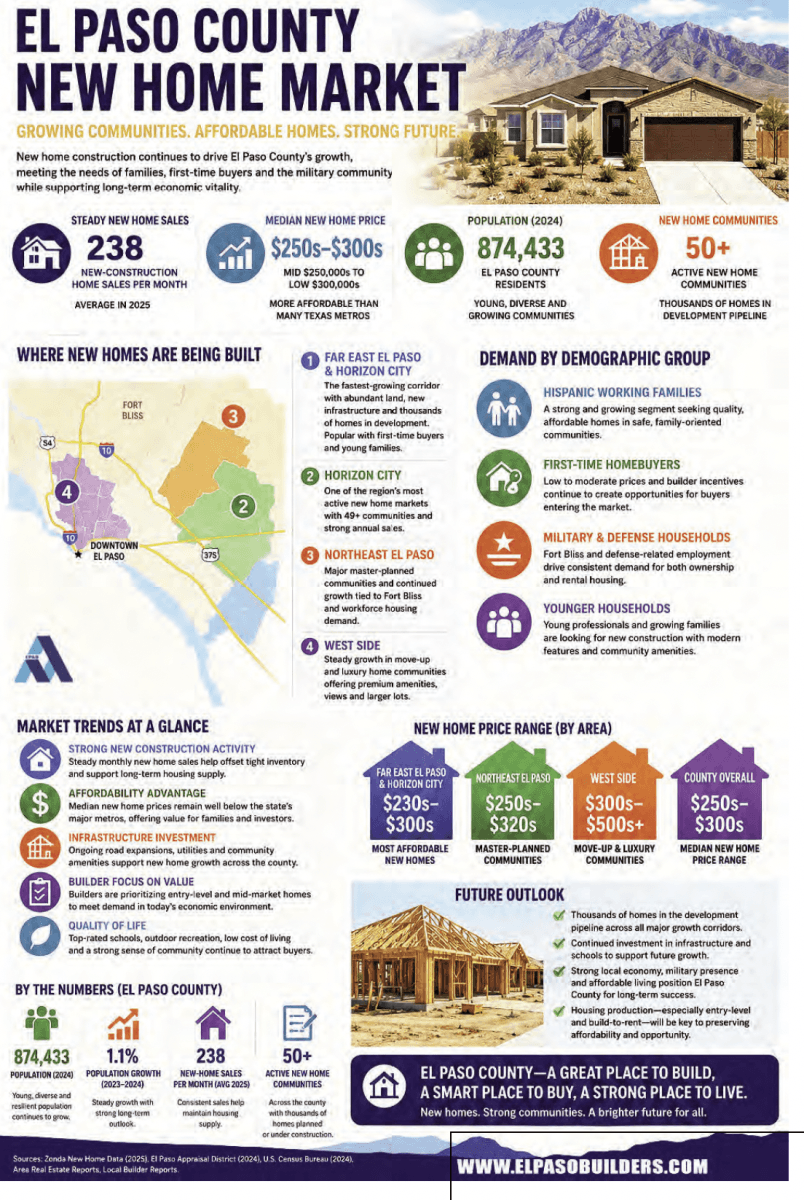
Although El Paso remains more affordable than many Texas and national housing markets, affordability pressures are still significantly impacting local families. Many buyers today are extremely payment sensitive, meaning that even small increases in interest rates, insurance costs, or monthly payments can determine whether a family qualifies for a home loan. Affordability challenges are no longer affecting only first-time buyers. Many middle-income families are also feeling the strain.
One of the largest challenges continues to be elevated mortgage rates and financing costs. In today’s market, affordability is often less about the sales price alone and more about the monthly payment structure. Builders are also impacted by higher borrowing costs associated with land acquisition, development financing, construction loans, and operations. Rising material costs, fuel prices, transportation expenses, utilities, and labor costs continue to increase the overall cost of housing. Construction material costs alone have risen dramatically since 2020, significantly outpacing overall inflation.
Labor shortages also remain a major concern nationally and locally. Skilled trades such as electricians, plumbers, HVAC technicians, framers, and concrete crews continue to be in high demand. Workforce shortages not only affect construction schedules but also impact permitting, inspections, engineering, and overall development timelines. These delays ultimately increase costs and reduce housing supply.
Another important issue in El Paso is lot availability and infrastructure readiness, particularly in West El Paso. Builders need predictable access to developed lots, utilities, drainage systems, and roadway infrastructure in order to maintain stable housing production. Delays in lot releases and infrastructure development can significantly affect affordability and supply.
Despite these challenges, I remain optimistic about the future of housing both nationally and locally. Our industry has consistently demonstrated resilience, innovation, and adaptability. Organizations such as the National Association of Home Builders, the Texas Association of Builders, and the El Paso Association of Builders continue advocating for policies that support affordability, workforce development, infrastructure investment, and responsible growth. Through collaboration between builders, industry partners, educators, local government, and community leaders, we can continue working toward solutions that strengthen housing opportunities and help more families achieve the dream of homeownership.
|
|

Message from acting EPAB Executive Vice President

Edgar Garcia
2020 President
2026 Vice President
El Paso Association of Builders
Bella Vista Homes
The last couple of months have tested the strength and resilience of the El Paso Association of Builders in ways few could have anticipated. Ray Adauto has served as the steady hand guiding the Association and his absence has been felt throughout the organization. From the daily operations to the relationships he cultivated across the home building community, there is no denying that Ray’s impact helped shape the EPAB.
Behind the scenes, I, along with EPAB President, Lydia Mlouhi and the Executive Board, have worked to ensure the Association remains stable and forward focused. Together, we have taken on the challenge of creating new systems and implementing processes designed to improve our efficiency. The leadership team has demonstrated that while change may be difficult, it can also create opportunities for the EPAB.
We are taking this momentum and moving the Association forward, that optimism was on full display during the recent EPAB Block Party membership drive. The event drew an outstanding turnout, bringing together builders, associates, and future members for an evening filled with networking. Most encouraging was the surge of new memberships, which has reinvigorated the Association and the growing excitement and engagement from the home building community signals that even during times of change, progress continues to build.
|
|
|
|


Which Home Owners Are Fueling Today’s Remodeling Market?

With elevated mortgage rates and limited for-sale inventory making it harder to move, many home owners are instead choosing to invest in the homes they already own.
In 2024, an estimated $670 billion was spent on remodeling projects, as roughly 20 million households (nearly one-quarter of owner-occupied homes) undertook home improvements ranging from large additions and major renovations to smaller alterations and upgrades.
NAHB analysis of data from the Consumer Expenditure Survey (CES) reveals how these remodeling expenditures varied across household characteristics. For example, married-couple households remain the dominant force in remodeling, accounting for the majority of both the number of projects and the amount of spending.
Families with children, particularly those with kids ages 6-17, are investing heavily in larger-scale improvements like finished basements, kitchen upgrades, and home additions to better accommodate growing households. In fact, these households reported some of the highest spending levels across all categories, averaging $43,330 spent in 2024.
When comparing generational groups, Baby Boomers represented the largest share of total remodeling expenditures. Meanwhile, Millennials are emerging as the highest spenders per remodeling household, often focusing on additions and long-term upgrades that support growing families, remote work, and evolving lifestyle needs.
The analysis also highlights life-cycle patterns that correlate with remodeling behavior. Home owners ages 35–44 and 55–64 reported the highest remodeling expenditures, suggesting two major waves of investment: one tied to family formation and another linked to pre-retirement and aging-in-place preparations.
Income remains another major factor shaping remodeling demand. Higher-income households (those with $200,000 or more in annual income) are three times as likely to renovate than those earning less than $50,000. On average, high-income households that remodeled in 2024 spent about $61,000.
|
|

ECONOMIC OUTLOOKs
Fuel Folly
There’s currently talk of suspending the $0.184/gallon federal gasoline tax. This would not only cost the Treasury $3.5 billion/month, but it’s bad policy, by inverting market signals that encourage conservation with a push towards increased consumption. Instead, use the money to give all 130 million US households a check for $27/month so they can spend the money how they wish. Then, because gasoline is not deliberately subsidized, consumption will fall.
Muted Momentum
April pending home sales rose 1.4%, better than the 0.9% expected but down from 1.7% last month. More importantly, Y-o-Y sales rose 3.2%, which at first glance looks passable until one recalls that last April was when “Liberation Day” tariffs were imposed, causing the stock market to swoon. So, a rise of 3.2% is hardly the stuff dreams are made of. Over the last 6 months pending sales have slid 1.1%.
Uneven Upswing
The key economic problem, and the primary reason the bottom third or half of the population is struggling, is because of the near complete stagnation in real after-tax personal income. Corporate earnings are excellent, due in part to stellar productivity growth, and relative to national income and GDP, they continue to hit new peaks. This buoys equities and turbocharges spending by the wealthy, all part of this K-shaped economic cycle.
Chair Challenges
Kevin Warsh is the 17th Fed Chairperson. Since the start of the 5th Chairperson, Eugene Meyer on 9/16/30, the average return of the S&P 500 during the first three months of the new Chair’s term has been -12%. The worst was Alan Greenspan, whose term commenced on 8/11/87. He saw the market decline 33%; Eugene Mayer follows closely at -32%. The best performer, Ben Bernacke at 2%. Hold on tight.
Positive Production
April industrial production was surprisingly strong, rising 0.7% M-o-M with a 20bps upward revision to March. Manufacturing jumped 0.6% M-o-M and March was also revised up 20bps; nice. But the strength is highly selective and fits with the macro themes currently driving the economy. AI-related capital spending was up 1.5% M-o-M, defense restocking tied to the Iran conflict and utilities production were both up 1.9% M-o-M. Strong but painfully uneven.
Flat Fields
The Friday File: The state with the smallest difference between the highest and lowest elevation is Florida at 345ft. Delaware follows at 448ft, then Louisiana at 543ft, Mississippi at 806ft, RI at 812ft, and Indiana at 937ft. Alaska has the largest differential at 20,320ft, then California at 14,776ft, Washington at 14,411ft, Hawaii at 13,796ft, Nevada at 12,661ft, and Arizona at 12,563ft. The median is 4,441ft, Colorado is 10th at 11,118.
Critical Compute
AI-driven demand is reshaping not only data-center investment but also financial innovation. CME Group is exploring a futures market for AI compute capacity. AI infrastructure is now sufficiently large, volatile, and capital intensive to require hedging tools. Tradable compute futures could offer real-time price signals for AI infrastructure scarcity, cloud margins, and data-center buildout. The market would include benchmarks like the H100 Rental Index, which tracks Nvidia H100 GPU rental costs.
Dormant Dwellings
April existing home sales came in at 4.02 million, up 0.2% M-o-M and flat Y-o-Y, putting an exclamation point to a failed spring selling season. Moreover, inventory is up 5.8% Y-o-Y which pushed months of inventory to 4.4 from 4.2 in March and 3.8 in Jan/Feb. Home price appreciation, if you can call it that, rose 0.9% Y-o-Y, but with inflation at 3.8%, real home prices fell 2.9% Y-o-Y!
Tariff Trade
SCOTUS invalidated all country-specific tariffs. Last week another court invalidated the tariffs introduced to replace the initial tariffs. This means replacement tariff monies will also have to be returned to the importers/wholesalers/retailers, which will boost their profits as they ALREADY passed the costs on to households. It’s hard to think of a more economically destructive illegal policy, hated by everyone, that boosts corporate profits at the expense of households.
Elliot Eisenberg, Ph.D. is an internationally acclaimed economist and public speaker specializing in making economics fun, relevant and educational. Dr. Eisenberg earned a B.A. in economics with first class honors from McGill University in Montreal, as well as a Master and Ph.D. in public administration from Syracuse University. Eisenberg is the Chief Economist for GraphsandLaughs, LLC, a Miami-based economic consultancy that serves a variety of clients across the United States. He writes a syndicated column and authors a daily 70-word commentary on the economy that is available at www.econ70.com.
|
|